Idempotency - Theory and Practice
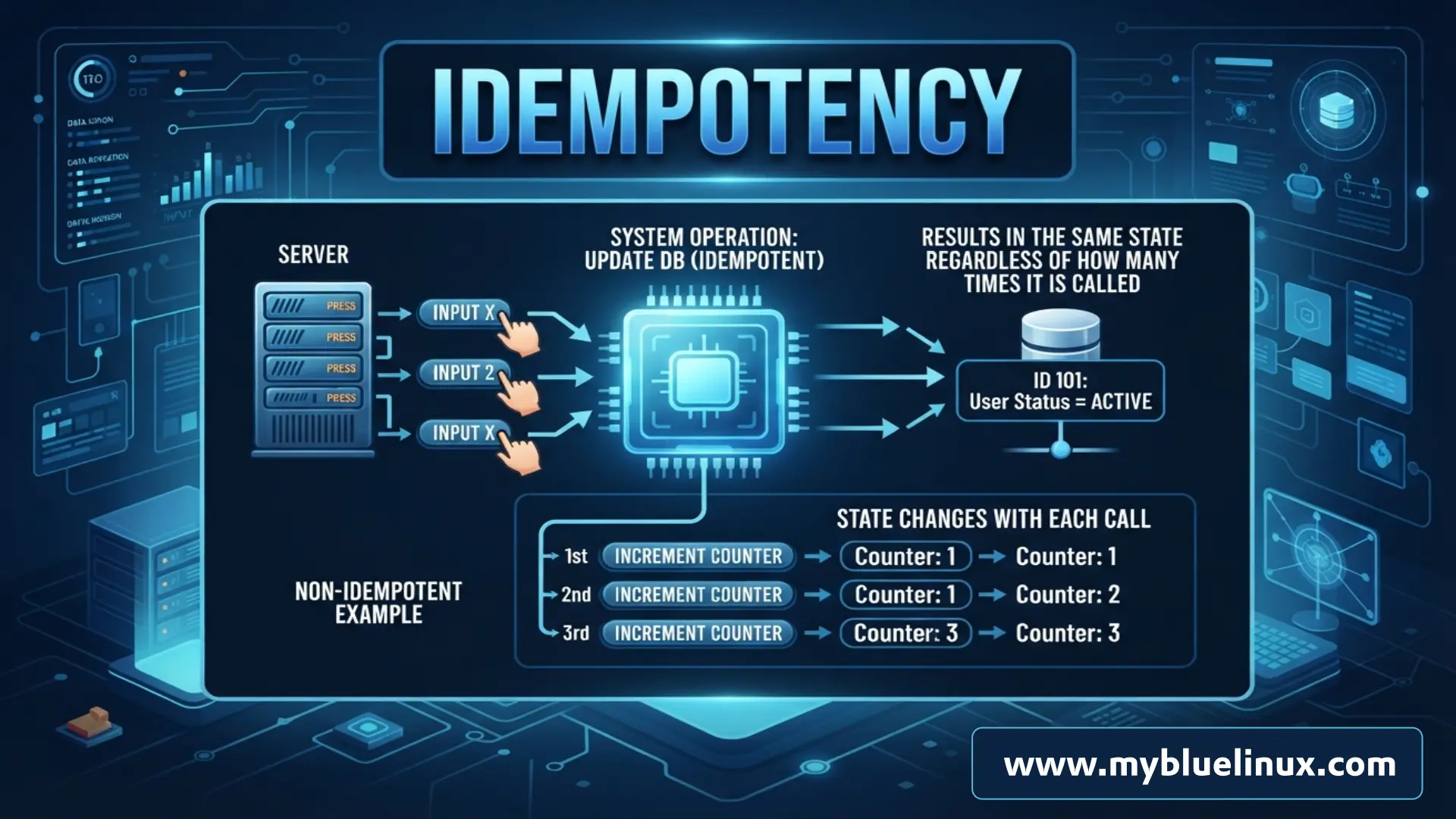
Part I - The Surprisingly Deep Foundations of Idempotency
More than a Buzzword that you hear in the system design interviews and technical documents
In the grand lexicon of intimidating computer science jargon, the word “idempotent” sits comfortably near the top. It’s a five-dollar word that gets thrown around in system design interviews and technical architecture documents, often as a vague hand-wave toward reliability. But it’s not just a buzzword. It’s a fundamental, powerful, and surprisingly deep concept that separates fragile systems from resilient ones.
Many articles will give you the quick definition — “doing something multiple times has the same effect as doing it once” — and then immediately jump to API keys. We’re not going to do that. To truly master this concept, we need to strip it down to the studs. We’ll start with its roots in pure mathematics, understand its critical importance in modern business systems, and see how it’s woven into the very fabric of the internet itself.
By the end of this article, you won’t just know what idempotency is; you’ll understand why it is one of the most important principles for building trustworthy software.
Press enter or click to view image in full size
Back to School — The Mathematical Roots of Idempotency
Before idempotency was a property of an API, it was a property of a mathematical function. The formal definition is beautifully simple:
A function,
f, is idempotent if, for any valuexin its domain,f(f(x)) = f(x).
In plain English: applying the function to its own result doesn’t change the result any further. The operation converges to a fixed point in a single step. Let’s make this tangible with some simple examples:
- The Absolute Value Function:
abs(x). If we takex = -5, thenabs(-5) = 5. If we apply the function again,abs(5) = 5. Sinceabs(abs(-5)) = abs(-5), the function is idempotent. - Multiplying by Zero:
f(x) = x * 0. If we takex = 10, thenf(10) = 0. If we apply it again,f(0) = 0. The operation is idempotent. - Rounding to the Nearest Integer:
round(x). If we takex = 3.14, thenround(3.14) = 3. If we apply it again,round(3) = 3. The operation is idempotent.
Now, let’s look at a non-idempotent function:
- Adding One:
f(x) = x + 1. If we takex = 5,f(5) = 6. If we apply it again,f(6) = 7. Clearly,f(f(5)) != f(5). Each application changes the state. This operation is not idempotent.
This isn’t just academic trivia. In the world of software, our “function” is an entire API call, and “x” is the state of our entire system. An idempotent API call is one that, if received twice, will leave the system in the same state as if it had only been received once. An API call that increments a counter is the software equivalent of f(x) = x + 1, and it's the source of countless bugs.
The Business Imperative — Why This Nerd Stuff Matters
Understanding the math is one thing, but the real reason we care about idempotency is that its absence can have catastrophic business consequences.
Use Case 1: Event-Driven Architectures & The Phantom Order
Modern systems are increasingly built as a collection of microservices that communicate through events. Imagine an e-commerce platform: when an order is placed, an OrderCreated event is published to a message queue like Kafka or RabbitMQ.
Several services subscribe to this event. An InventoryService needs to deduct stock. A NotificationService needs to send an email. Message queues, to ensure reliability, often provide an "at-least-once delivery" guarantee. This means that under certain failure conditions (like a network blip), the queue might play it safe and deliver the exact same OrderCreated event to the InventoryService twice.
- If the “process order” function is not idempotent, it will receive the second event and dutifully deduct the stock again. This corrupts your inventory data and can lead to overselling.
- If the function is idempotent, it will recognize the event ID from the first delivery and simply ignore the second one, saving the system’s integrity.
Use Case 2: The “Oops, Run it Again” Data Pipeline
Consider a common data engineering task: a nightly script that reads a 10-million-line CSV file of new user data and imports it into a database. The script runs, chugs along for an hour, processes 5 million rows, and then fails due to a temporary network error.
- If the import script is not idempotent, the engineer is in a terrible position. If they re-run the script, it will create 5 million duplicate user records before continuing. This requires a painful data cleanup process.
- If the script is idempotent (e.g., it’s designed to “upsert” based on a unique user email), it can be safely re-run. The script will see the first 5 million users, recognize they already exist, and skip them, seamlessly picking up where it left off. This turns a multi-hour data disaster into a non-event.
The Language of the Web — Idempotency in the HTTP Specification
This principle is so fundamental that it’s baked directly into the specification for HTTP, the protocol that powers the web. The “function” here is the HTTP method.
Further reading: Idempotency Explained Simply
The Safe & Idempotent Methods: GET, PUT, DELETE
The HTTP spec formally defines certain methods as idempotent, creating a contract that server and client infrastructure (like caches and proxies) can rely on.
GET,HEAD,OPTIONS: These are considered safe methods, which is a stronger guarantee than idempotency. It means they should never have any side effects or change the state of the server. They are purely for retrieval.PUT /articles/123: ThePUTmethod is defined as a complete replacement of a resource at a given URL. If youPUTa JSON object{ "title": "My Great Article", "content": "..." }to that URL, the first request creates (or updates) the article. If you send the exact same request again, you are simply replacing the resource with the same data. The final state of the article is identical. Therefore,PUTis idempotent.DELETE /articles/123:DELETEis also idempotent. The first request will delete the article, and the server will likely return a204 No Content. A second request to the same URL will find the article is already gone and return a404 Not Found. The status code is different, but the state of the system—that article 123 does not exist—remains unchanged.
The Non-Idempotent Methods: POST and PATCH
The specification explicitly calls out these methods as non-idempotent, signaling to developers that they require special care.
POST /articles:POSTis the most common method for creating a new resource. If youPOSTa new article payload to the/articlescollection twice, the server's correct behavior is to create two new, separate articles, each with its own unique ID. The action is not idempotent.PATCH /articles/123:PATCHis used for partial updates. Imagine a request to increment a counter:PATCH {"op": "increment", "path": "/view_count"}. Sending this request twice would (and should) increment the view count twice. Therefore,PATCHis not idempotent.
It is precisely because POST and PATCH are not idempotent that they are the primary candidates for the client-supplied idempotency keys. They are the operations that carry the risk of the "double-charge nightmare."
Conclusion
Idempotency is not a feature you tack on at the end. It’s a fundamental design principle that begins with understanding its mathematical definition, recognizing its critical role in preventing costly business errors, and respecting its formalization within the HTTP protocol. It is the bedrock of reliable systems.
Part II - Deep Dive into the Idempotency Key
Why your whole Idempotent API rests on just one key?
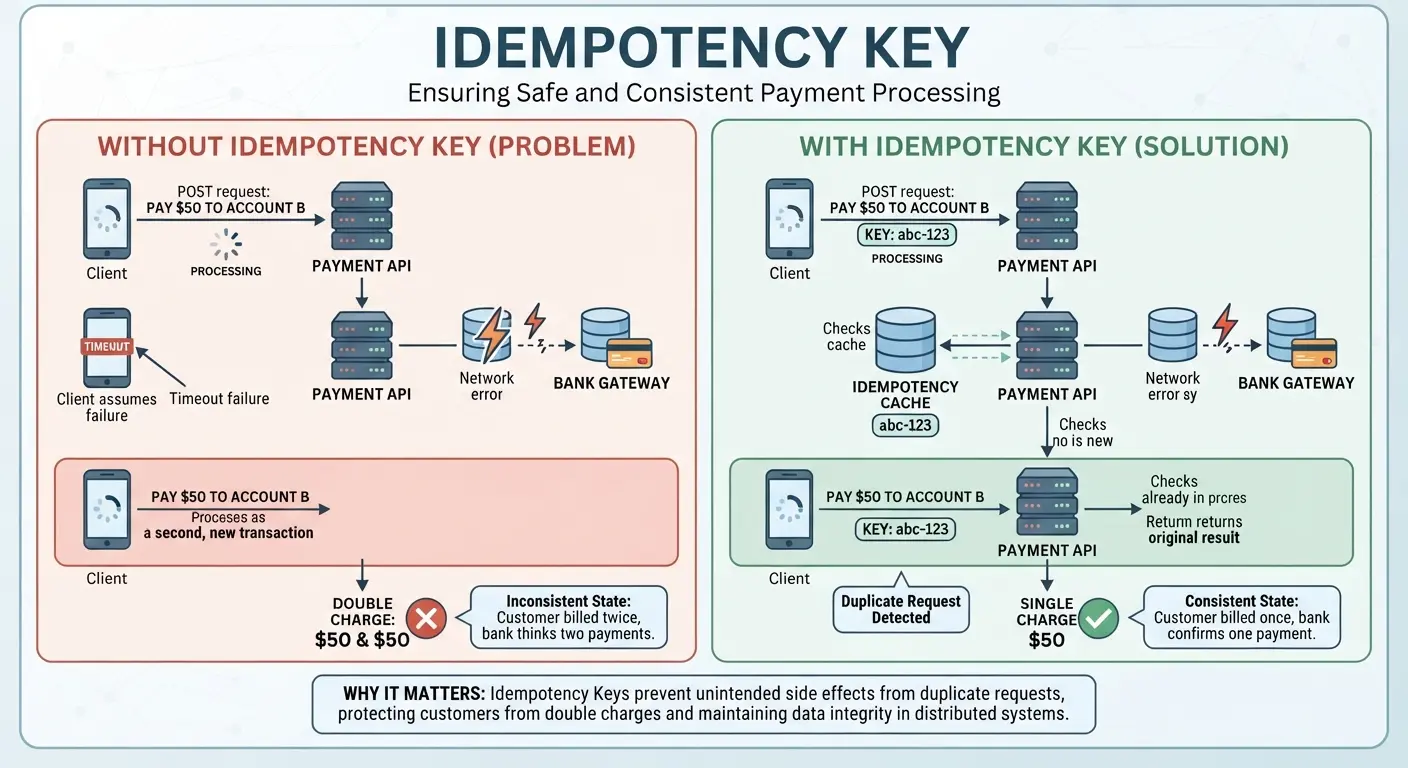 why is idempotency key so important
In discussion above, we established that certain API operations, like POST /payments, are inherently dangerous. They are the software equivalent of a button that, if pressed multiple times, just keeps dispensing money. We need a way to build a "memory" into our server, a mechanism to distinguish between a genuinely new request and a panicked, network-induced retry of a request we've already handled.
The solution is a beautifully simple contract between the client and the server, a digital handshake facilitated by a single piece of data: the Idempotency Key.
Press enter or click to view image in full size
This isn’t just about adding a random header to your API call. Oh no. That’s like saying building a car is “just about adding an engine.” The key is the start of a complex, stateful dance. How is it generated? How is it validated? What is its lifecycle? Getting any of this wrong can render your entire idempotency system useless, or worse, make it a source of even more confusing bugs.
So, let’s put on our engineering hats and build this thing from the ground up, starting with the client’s first and most important job.
The Genesis — Crafting the Perfect Key
The entire system hinges on the client’s ability to generate a key that is, for all practical purposes, unique for every distinct operation. A shaky key generation strategy is the original sin of a bad idempotency implementation. The server has to trust the client’s key, so the client better do a good job. Let’s analyze the leading strategies.
Strategy 1: The Workhorse — UUIDs
Universally Unique Identifiers (UUIDs) are the go-to choice for idempotency keys, and for good reason. They are 128-bit numbers represented as a 36-character string, and the probability of two independently generated UUIDs colliding is so infinitesimally small it’s not worth losing sleep over. But not all UUIDs are created equal.
UUID v4 (The Random One): This is the most common type. It’s generated from pure randomness.
- Example:
f47ac10b-58cc-4372-a567-0e02b2c3d479 - Pros: Dead simple to generate in any language. The randomness means there’s no information leakage about when or where it was created.
- Cons: The randomness is also its biggest weakness when it comes to database performance. When you use UUIDv4 as a primary key in a database index (like a B-Tree), each new key is a random dart thrown at the index. This leads to index fragmentation and poor write locality, as the database has to jump all over the disk to insert new entries. For an idempotency key lookup table that sees heavy writes, this can become a significant performance bottleneck.
UUID v7 (The Time-Ordered One): A newer, increasingly popular standard. It combines a timestamp with random bits.
- Example:
018a99a4-6e1d-7201-9545-e11b31278f24(The first part is a high-precision timestamp). - Pros: This is the holy grail for database indexes. Because the keys are generated in a roughly sequential, time-ordered manner, new entries are always added to the “end” of the index. This is fantastic for write performance and avoids fragmentation. It’s the same reason your database loves
auto-incrementing BIGINTprimary keys. - Cons: It leaks the creation time of the key, which is a minor information disclosure. For most use cases, this is irrelevant.
Verdict: If you have the choice, use UUID v7. It gives you all the uniqueness of a UUID with the database performance of a sequential ID. If your language’s libraries don’t support it yet, UUID v4 is still a solid, reliable choice.
Strategy 2: The Stateless Wonder — Hashing the Request
What if the client can’t or won’t maintain state to remember a key? An alternative is to generate the key by hashing the request’s payload.
- How it works: The client (or a proxy) takes the entire request body, maybe along with some headers, and runs it through a fast, non-cryptographic hash function like SHA-256. The resulting hash becomes the idempotency key.
- Pros: The client doesn’t need to save anything! The key is a pure function of the request itself.
- Cons: This strategy is brittle and full of pitfalls.
- Sensitive Data: You are now hashing and potentially storing PII or payment details, which can be a security nightmare.
- Ambiguity: What if a user adds an insignificant, optional field to a retry?
{"amount": 100}vs.{"amount": 100, "memo": "for lunch"}. These produce different hashes and will be treated as two separate operations, leading to a double charge. - Requires Strict Canonicalization: To make it work, you’d need a rigid process to sort keys and normalize the payload before hashing, which is complex and error-prone.
Verdict: Avoid this unless you have a very specific, controlled use case. The elegance of being stateless is rarely worth the fragility.
The Contract — The Rules of the Handshake
Once the client has a key, it initiates the handshake. This is a formal contract with specific rules and error conditions.
The Header: Idempotency-Key
The key is sent as a standard HTTP header. While you might see older systems using X-Idempotency-Key, the X- prefix for custom headers has been deprecated since 2012. The modern convention is just Idempotency-Key.
POST /v1/payments Content-Type: application/json Idempotency-Key: 018a99a4-6e1d-7201-9545-e11b31278f24
The Most Important Client-Side Rule
Here is the rule that separates a toy implementation from a production-ready one:
The client MUST persist the generated idempotency key to its local storage before making the first network call.
Why? Imagine the client app generates a key in memory, sends the request, and then the user’s phone crashes. When the app restarts, the in-memory key is gone. The app has no idea if the payment went through. So it generates a new key and tries again, leading to a potential double charge. By saving the key first ([START PAYMENT ATTEMPT transaction_123 with key xyz]), the client can recover from its own failures and safely retry with the correct key.
The Server’s Error Responses (The Fine Print)
The server must respond with specific error codes when the client breaks the contract.
400 Bad Request: Sent if the client calls a required idempotent endpoint without anIdempotency-Keyheader. This is a basic contract violation.422 Unprocessable Entity: Sent if the client reuses a key with a different request payload. This signals a dangerous misuse of the key.409 Conflict: Sent if the client makes a request with a key that is currently being processed by another request. This prevents race conditions.
The Server’s Memory — The Lifecycle of a Key
On the server, an idempotency key is not just a string; it’s a stateful entity. We can model its life as a state machine.
- 1. State:
non-existent - This is the starting point. The server has never seen this key before. The request is considered new and legitimate.
- 2. Transition:
LOCK - Upon seeing a new key, the server immediately attempts to create a “lock” record for it in its storage layer. This record should have a status of
processing. - This is the most critical step for preventing race conditions, and we will explore how to do this atomically in monolithic vs. distributed systems in our next articles.
- 3. State:
locked/processing - The server is now actively working on the request’s business logic. If another request arrives with the same key while in this state, it receives a
409 Conflictand is rejected. - 4. Transition:
COMPLETEorFAIL - Once the business logic finishes, the outcome is determined. It either succeeded or it failed. The server caches the entire result (status code, headers, and body).
- 5. State:
completed/failed - The lock is now updated with the final, cached result. The operation is done. Any subsequent request with this key will hit this record, and the server will immediately return the cached response without re-running any logic.
- 6. Transition:
EXPIRE - Eventually, the key is no longer needed. A TTL (Time-to-Live) mechanism purges the key from the store.
- 7. State:
expired(back tonon-existent) - The key is gone. If a request arrives with this key now, it will be treated as a brand new request.
Seeing the states do you think there can be case when our system is just LOCKED? Like What happens when key is in processing and server crashes and the processing part has stopped and not continuing? Zombie Lock
The Zombie Lock
Imaginge this set of events that could cause the zombie lock.
- 11:40:01 PM: A
POST /paymentsrequest arrives withIdempotency-Key: key-123. - 11:40:01 PM: Our server, Server A, sees
key-123is new. It dutifully creates a lock in our central cache (let's say, Redis):SET 'key-123' 'processing'. - 11:40:02 PM: Server A begins the actual work — it makes a network call to the Stripe payment gateway. This can take a few seconds.
- 11:40:03 PM: Catastrophe! A deployment script accidentally kills the process on Server A. The server is dead. The in-flight payment processing logic vanishes into the ether.
The state of our system is now dangerously inconsistent:
- The client is waiting for a response that will never come.
- The payment gateway might have received the request, or it might not have. We don’t know.
- Crucially, our central idempotency store now contains a zombie lock: a key (
key-123) that is permanently stuck in theprocessingstate with no process left alive to ever complete it.
The Consequence: A Self-Inflicted Outage
Now, the client, being well-behaved, times out after 15 seconds and decides to retry the request.
- 11:40:16 PM: The client resends the exact same request with
Idempotency-Key: key-123. - The request goes to a healthy server, Server B.
- Server B looks up
key-123in Redis. It finds the key, and its status isprocessing. - Following our rules, Server B has no choice but to assume there’s a race condition. It returns a
409 Conflicterror to the client.
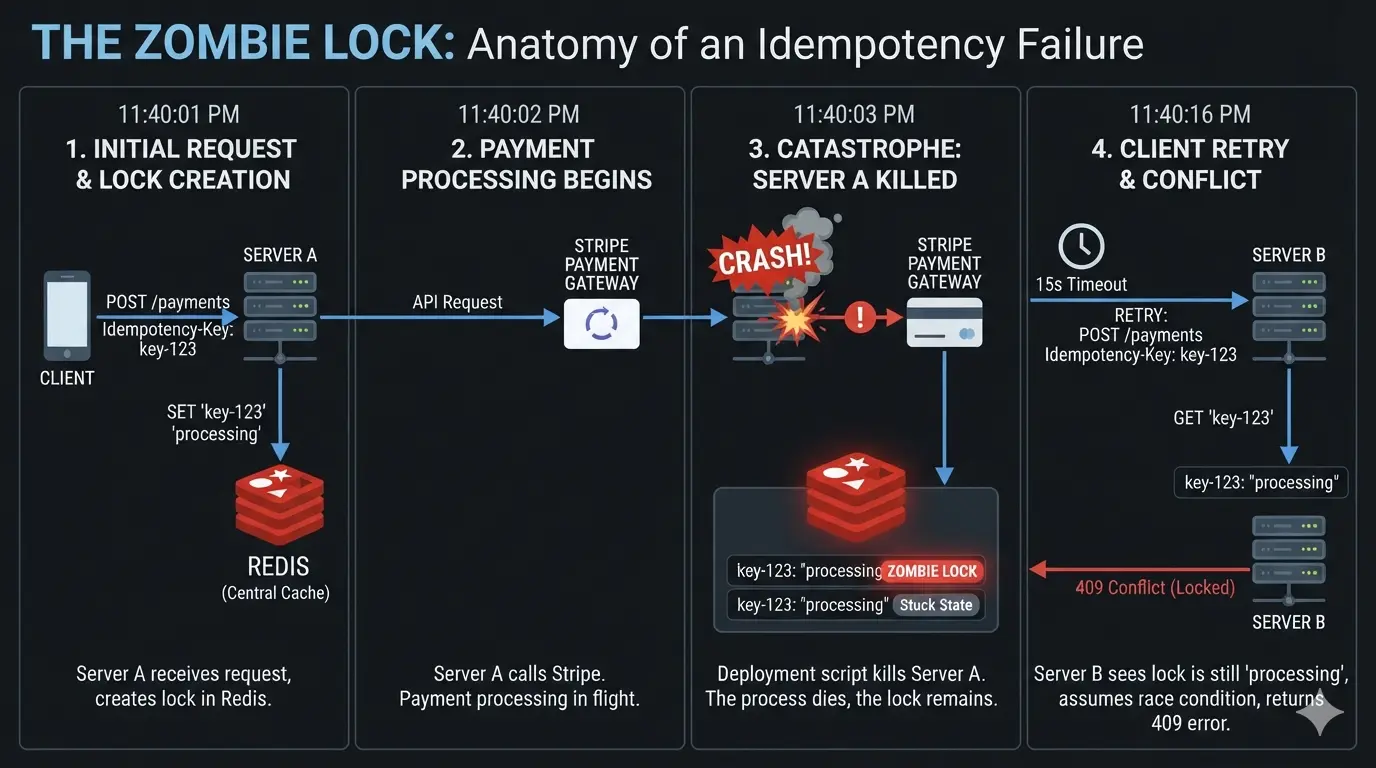
The user is now stuck in a loop. Every retry hits the zombie lock and is rejected. You haven’t just failed a single request; you have made it permanently impossible for this specific payment to ever be processed, all because of a temporary server crash. You have created a self-inflicted, targeted outage.
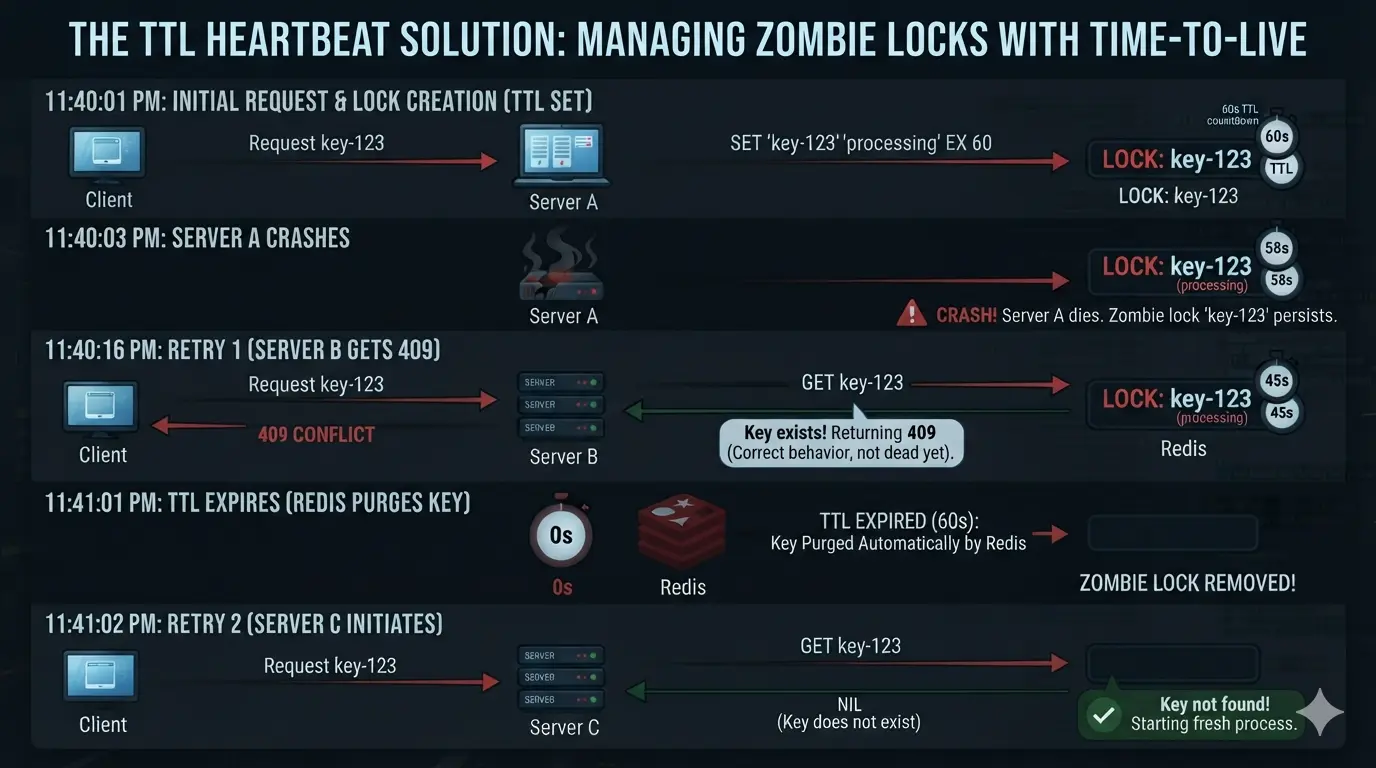
The Solution: The Time-to-Live (TTL) Heartbeat
The solution is to treat the processing lock not as a permanent state, but as a temporary lease or a heartbeat. We achieve this by setting a Time-to-Live (TTL) on the lock when we create it.
Let’s rewind the timeline with this new, improved logic:
- 11:40:01 PM: Request for
key-123arrives. - 11:40:01 PM: Server A creates the lock, but this time with a TTL. The command is
SET 'key-123' 'processing' EX 60. TheEX 60tells Redis: "Automatically delete this key after 60 seconds." - 11:40:02 PM: Server A begins processing.
- 11:40:03 PM: Server A crashes. The zombie lock
key-123still exists in Redis.
But the clock is ticking.
Now, when the client retries:
- Retry at 11:40:16 PM: The client hits Server B. The key still exists. Server B returns
409 Conflict. This is actually correct behavior. We don't want to retry too aggressively, as the original request might just be slow, not dead. - The Magic Happens at 11:41:01 PM: The 60-second TTL on the key expires. Redis automatically purges
key-123from existence as if it were never there. - Retry at 11:41:02 PM: The client, perhaps after a longer backoff period, tries one last time. It hits Server C. Server C looks up
key-123in Redis... and finds nothing. It's gone. The key is nownon-existent. - Server C treats this as a brand new request and safely initiates the process from the beginning.
The TTL on the processing lock acts as a dead man's switch. If the server fails to complete its work and update the key to a permanent completed state within the TTL window, the system assumes the process is dead and automatically cleans up the lock, allowing the operation to be safely retried later.
The All-Important Question: How Long Should the TTL Be?
Choosing the right TTL is a critical design decision and a trade-off:
- Too Short: Imagine your payment gateway is unusually slow one day, and a valid transaction takes 30 seconds. If your TTL is 20 seconds, the lock could expire while the first request is still legitimately processing. A client retry could then start a new, parallel operation, creating the very double-charge we sought to prevent. This is a race condition.
- Too Long: If your TTL is 15 minutes, then a server crash will cause a 15-minute outage for that specific operation.
The Rule of Thumb: The TTL for a processing lock should be set to your maximum reasonable p99.9 latency for that specific operation, plus a healthy buffer. If your API call to the payment gateway almost never takes more than 10 seconds, a TTL of 60 seconds is a very safe starting point.
Conclusion
As we’ve seen, the idempotency key is not a simple token. It’s the centerpiece of a complex protocol that requires careful implementation on both the client and the server. It demands a robust key generation strategy, a strict adherence to the client-server contract, and a well-defined state machine on the backend.
Part III - Implementing Idempotency in a Monolithic System
Why Idempotency is monolith system is easier and you just need few things?
You’ve designed the perfect API. Your business logic is flawless. But as we’ve established, without an idempotency layer, it’s a house of cards waiting for a network hiccup to knock it all down. We need a gatekeeper — a piece of code that stands guard in front of our precious business logic, inspecting every request’s credentials before granting it passage.
The perfect architectural pattern for this is middleware.
Section 1: The Middleware Pattern — A Digital Bouncer
Middleware (or a decorator/filter, depending on your framework) is a layer of code that intercepts an incoming HTTP request before it reaches your main application logic (your controller or view). It can inspect the request, modify it, and even decide to reject it entirely without ever bothering your business code.
Our idempotency middleware will be the ultimate bouncer. Its job is simple:
- Check the request’s ID (
Idempotency-Key). - Check the guest list (our storage layer) to see if this ID has been here before.
- Based on the list, either:
- Let them in: It’s a new request. Let it pass to the main logic, but keep an eye on it.
- Show them the door: This request is a duplicate of one that’s already in progress. Reject it with a
409 Conflict. - Remind them of their last visit: This is a duplicate of a completed request. Don’t let them back in, but kindly give them the exact same result they got last time.
After the request is handled by the main logic, the middleware has one final job: to record the outcome on the guest list for future reference.
This pattern is beautiful because it completely decouples the idempotency concern from your business logic. Your payment processing code doesn’t need to know anything about idempotency keys; it just processes payments. The middleware handles everything else.
Section 2: Choosing Your Weapon — A Deep Dive into Storage Layers
Our middleware needs a “guest list” — a place to store the state of each idempotency key. This storage layer is the heart of the system, and your choice here involves a critical trade-off between consistency and performance.
Option A: The Trusty Relational Database (e.g., PostgreSQL)
- Why choose it? Your first instinct might be to use the database you already have. It’s reliable, durable, and supports ACID transactions, which is exactly what we need for a process that must be correct.
- The Schema: We’d create a dedicated table to store our keys. A robust schema would look something like this:
CREATE TABLE idempotency_keys (
    -- The key provided by the client
    key UUID PRIMARY KEY,
-- The state of the operation
    -- ('processing', 'completed', 'failed')
    status VARCHAR(20) NOT NULL,
    -- A hash of the request payload to prevent key reuse
    payload_hash VARCHAR(64) NOT NULL,
    -- The cached response to send back on retries
    response_code SMALLINT,
    response_body JSONB,
    -- Timestamps for locking and garbage collection
    created_at TIMESTAMPTZ NOT NULL DEFAULT NOW(),
    unlocked_at TIMESTAMPTZ NOT NULL
);
- The Concurrency Problem: Here’s the trap. A naive implementation would be:
SELECT * FROM idempotency_keys WHERE key = ?If not found in code, then…INSERT INTO idempotency_keys ...- This is a classic race condition. If two identical requests arrive at the same millisecond, both
SELECTstatements could run, find nothing, and then bothINSERTstatements would run, causing one to fail with a primary key violation, or worse, both processing the payment. - The SQL Solution (
SELECT ... FOR UPDATE): To solve this, we need to use a pessimistic lock within a transaction. TheFOR UPDATEclause tells PostgreSQL: "Lock the rows returned by thisSELECT. Don't let any other transaction touch them until I'm done." - The correct, race-condition-free logic looks like this:
-- Start a transaction
BEGIN;
-- Attempt to get an exclusive lock on the row.
-- If the row doesn't exist, Postgres can still lock the "gap"
-- preventing concurrent inserts with the same key.
SELECT * FROM idempotency_keys WHERE key = 'key-123' FOR UPDATE;
-- ... in your application code, check if a row was returned.
-- If YES: The key exists. Return the cached response or a 409.
-- If NO: The key is new. You have the lock.
INSERT INTO idempotency_keys (key, status, ...)
VALUES ('key-123', 'processing', ...);
-- End the transaction, releasing the lock.
COMMIT;
-- ... NOW, run your slow business logic (e.g., call Stripe) ...
-- After finishing, update the record with the final result.
UPDATE idempotency_keys
SET status = 'completed', response_code = 201, ...
WHERE key = 'key-123';
Option B: The Speed Demon (Redis)
- Why choose it? Your idempotency check happens on every sensitive request. It needs to be lightning fast. Redis, an in-memory key-value store, is built for this kind of speed.
- The Data Structure: A simple key-value pair is sufficient. The key is the idempotency key, and the value can be a JSON string containing the status, payload hash, and cached response.
- The Concurrency Problem: The same
GETthenSETrace condition exists in Redis. - The Redis Solution (
SETNX): Redis provides atomic commands that are perfect for this. TheSETcommand has powerful, optional arguments. We can ask it to perform an atomic "set if not exists" and apply a TTL all in one command. - The correct, non-blocking logic looks like this:
# The command combines:
# - The key: 'key-123'
# - The value: a "processing" marker
# - EX 60: a 60-second TTL (our dead man's switch)
# - NX: ONLY set this key if it does NOT already exist.
SET 'key-123' 'processing' EX 60 NX
This single command is atomic. If two requests hit Redis at the same time, only one of them will succeed in setting the key.
- Your middleware runs the
SET ... NXcommand. - If the command returns
OK, you've successfully acquired the lock. You are the first. You can proceed with the business logic. - If the command returns
nil, another process beat you to it. The key already exists. You should thenGETthe key to check if its status isprocessing(return409 Conflict) or if it contains acompletedresponse (return the cached response).
Atomic Operations are Key
We’ve designed our middleware and explored two powerful storage options. The choice between them is a classic trade-off: the transactional safety and familiarity of your primary SQL database versus the raw, low-latency performance of a specialized cache like Redis.
But the unifying lesson is this: concurrency is a fact, even in a monolith. You cannot safely implement an idempotency check without using an atomic operation (SELECT ... FOR UPDATE in SQL, SETNX in Redis) to acquire a lock. This ensures that in the chaotic world of simultaneous requests, only one can be the first.
This all works beautifully… until you add a second server.
Part IV - Idempotency in a Distributed System
Why Idempotency is distributed system is much harder and how can you do it?
You’ve just deployed your application to two servers, Server A and Server B, sitting behind a load balancer. You're using a centralized Redis or PostgreSQL instance for your idempotency keys. Everything seems fine. But lurking in the nanoseconds of network latency is a bug so subtle and so dangerous it can undermine everything we've built.
Section 1: The Illusion of Safety Unveiling the Distributed Race Condition
Let’s set the stage. Our two servers are ready to accept traffic. A client, due to a network timeout, sends the same payment request twice in quick succession.
Here is the timeline of a disaster:
- T=0ms: The first request,
R1, withIdempotency-Key: key-xyzhits your load balancer. It's routed to Server A. - T=1ms: The retry,
R2, with the exact same key, hits your load balancer. It's routed to Server B. - T=5ms: Server A’s middleware logic begins. It connects to your central Redis and checks if
key-xyzexists. It doesn't. Server A concludes, "Aha! This is a new request. I shall proceed." - T=6ms: Server B’s middleware logic begins. Due to a nanosecond of network jitter, it runs just after Server A’s check but before Server A has had a chance to write a lock. Server B connects to Redis and checks if
key-xyzexists. It also finds nothing. Server B concludes, "Aha! This is a new request. I shall proceed."
The race is over, and we have lost.
Both servers, completely unaware of each other, now believe they are the rightful owner of this operation. Both will now call the payment gateway. Both will attempt to update the database. You have successfully engineered a perfect, distributed double-charge.
The atomic operations we celebrated in the last article (SETNX, SELECT FOR UPDATE) are still atomic at the database level, but the race condition is happening at the application level. Our logic ("check-then-act") is not atomic when distributed across multiple servers. We need a way to make the "check-and-act" (or more accurately, the "act-if-not-exists") a single, indivisible operation across the entire distributed system.
Section 2: Solution Pattern 1 — The Distributed Lock
The classic computer science solution to this problem is to use a distributed lock. This is a more robust locking mechanism that all nodes in a system can see and respect. Whichever server can acquire the distributed lock for key-xyz gets to proceed; all others must wait or fail.
How It Works (Using Redis)
Our previous SET ... NX command is actually the foundation for a simple distributed lock. The server that successfully executes SET 'key-xyz' 'processing' EX 60 NX is the one that has acquired the lock. The server that gets a nil response has failed to acquire the lock.
The critical difference is in the application logic:
- The logic must be a strict “try-lock-or-fail” pattern.
- The server that fails to get the lock must not proceed. It must immediately stop and revert to the “check the key’s status” logic (
GET key-xyz). It will then either see theprocessingstatus and return a409 Conflict, or, if the first server is incredibly fast, it might even see the finalcompletedresponse and be able to return the cached result.
The Dangers and Complexities
While this works, simple distributed locks are notoriously difficult to get right.
- Lease Time (TTL): As we discussed, you must have a TTL on your locks to handle server crashes. This is no longer just a good idea; it’s a mandatory requirement.
- Clock Drift: What if the clocks on your servers are out of sync? This can cause issues with the perceived expiry time of locks.
- Network Partitions: What if a server acquires a lock but is then partitioned from the rest of the system?
To solve these deeper issues, engineers have developed more complex solutions like the Redlock algorithm (which uses multiple, independent Redis masters to make the lock more fault-tolerant) or have turned to dedicated coordination services like Apache Zookeeper or etcd. These tools are purpose-built for distributed consensus and locking but add significant operational complexity to your stack.
Section 3: The Simpler, Better Way — Atomic Database Operations
For many, managing distributed locks in the application layer is a terrifying prospect. Luckily, there is often a much simpler, more robust pattern: offload the entire concurrency problem to your database.
Your distributed SQL database (like CockroachDB, or a properly clustered PostgreSQL/MySQL) has already solved the problem of distributed consensus. It is its entire reason for being. We can leverage this.
How it Works (with a UNIQUE Constraint)
This pattern is elegant in its simplicity.
- Ensure your
idempotency_keystable has aUNIQUEconstraint on thekeycolumn. - Now, rewrite your middleware logic to be “act-first-then-check.” When a request for
key-xyzarrives, the server doesn'tSELECTanything. It immediately tries toINSERT.
-- No SELECT first. Just try to write.
INSERT INTO idempotency_keys (key, status, payload_hash, ...)
VALUES ('key-xyz', 'processing', 'hash-abc', ...);
Let’s re-run our race condition scenario with this new logic:
T=5ms: Server A receivesR1and issues theINSERTstatement to the database.T=6ms: Server B receivesR2and issues the sameINSERTstatement.
The two INSERT statements arrive at the database cluster at roughly the same time. The database's own internal consensus and transaction logic takes over. Only one of them can succeed. The other will be rejected because it violates the UNIQUE constraint on the key column.
- The Winner: The server whose
INSERTsucceeds (let's say Server A) gets a success response from the database. It now knows it has acquired the "lock" and is the first and only processor of this operation. It can safely proceed to the business logic. - The Loser: The server whose
INSERTfails (Server B) will receive aUniqueViolationerror from the database. This error is now our signal. It tells us that we have lost the race. Our code should catch this specific error and, instead of crashing, should thenSELECTthe existing record forkey-xyzto find out its status and proceed accordingly.
This pattern is vastly superior for several reasons: it’s simpler to implement in your application code, it’s often more performant as it can be a single round-trip to the database, and it’s more robust because it relies on the decades of engineering that have gone into database concurrency control.
Conclusion
Surviving in a distributed environment means acknowledging that concurrent requests are not an edge case; they are a certainty. A naive “check-then-act” idempotency logic will fail.
The solution requires enforcing atomicity across your distributed system. You can do this by implementing complex distributed locks in your application layer, or you can take the often wiser path of leveraging your database’s built-in atomic constraints.